

Categoría: Entries in English

  • Robotic Infrastructure for Latin America: Technological Autonomy and Global Competitiveness in the Digital Economy of the 21st Century

    Latin America needs to develop its own robotic infrastructure—interoperable, context-sensitive, and strategically oriented—if it aims to participate with greater autonomy in the emerging global industrial economy. Robotics should no longer be understood merely as the acquisition of industrial arms, drones, or isolated automated systems. Rather, it should be conceived as a complex technological infrastructure that brings together physical robots, software-based automation, artificial intelligence, sensors, connectivity, data systems, cybersecurity, human talent, laboratories, standards, and local productive capabilities.

    This discussion is increasingly urgent. Around the world, the deployment of robotics is advancing at very different speeds across regions, deepening existing gaps in productivity, innovation, and industrial competitiveness. According to the International Federation of Robotics, China accounted for 54% of global industrial robot installations in 2024, with nearly 295,000 industrial robots installed that year, consolidating its position as the world’s largest robotics market. This trend confirms that robotics is no longer a peripheral technological asset. It has become a critical infrastructure for competing in the contemporary industrial economy.

    1. Robotics as Strategic Infrastructure

    For decades, robotics was mainly associated with advanced manufacturing and industrial automation. Today, however, that interpretation is too narrow. Robotics has become a cross-cutting infrastructure with applications in production, logistics, healthcare, agriculture, mining, energy, education, construction inspection, urban management, and services.

    To speak of robotic infrastructure is to recognize several interconnected layers. The first is a physical layer, composed of industrial robots, collaborative robots, drones, autonomous vehicles, mobile robots, sensors, actuators, laboratories, charging stations, and operational environments. The second is a digital layer, which includes robotic software, control platforms, digital twins, simulation systems, artificial intelligence, industrial Internet of Things architectures, APIs, cloud computing, and edge computing. The third is a data layer, focused on data capture, storage, analytics, traceability, model training, predictive monitoring, and data governance. Finally, there is an organizational layer that involves human talent, standards, regulations, cybersecurity, maintenance models, technological ethics, and business adoption strategies.

    From this perspective, a robotics policy for Latin America cannot be reduced to the purchase of equipment. It must instead build an architecture of capabilities capable of connecting industry, universities, the public sector, entrepreneurship, applied research, and talent development.

    2. The Geoeconomic Challenge: China Scales, the United States Innovates, and Latin America Adopts Slowly

    The international landscape reveals a profound gap. China has transformed robotics into a large-scale industrial policy. Its leadership cannot be explained solely by the size of its economy, but by the coordinated articulation of manufacturing capacity, financing mechanisms, local suppliers, technological development, productive automation, and industrial strategy. According to the International Federation of Robotics, China was not only the world’s largest market for industrial robots in 2024; it also surpassed two million industrial robots in operation, the largest operational stock globally.

    The United States, for its part, maintains significant strengths in research, artificial intelligence, software, startups, university laboratories, and advanced robotics. Nevertheless, even in the United States, there is growing recognition of the need for a more coordinated national strategy. In 2025, the Association for Advancing Automation proposed a vision for a national robotics strategy aimed at strengthening interinstitutional coordination, technological leadership, economic security, and robotic innovation.

    Latin America occupies a different position. The region has made progress in industrial automation, drones, educational robotics, healthcare applications, logistics, mining, precision agriculture, and process automation. However, it still lacks a sufficiently articulated regional robotic infrastructure. The Inter-American Development Bank has emphasized that robotics is transforming sectors such as manufacturing, logistics, agriculture, and services, while also highlighting the growing relevance of collaborative robots, drones, and humanoid systems in contemporary productive environments.

    In other words, Latin America’s gap is not only a robotics gap. It is also a gap in productivity, investment, talent, connectivity, industrial sophistication, data governance, technological financing, and public policy.

    3. Technological Autonomy: Beyond Dependence on Imported Platforms

    Technological autonomy should not be understood as technological isolation. Rather, it refers to the capacity to decide, adapt, integrate, maintain, audit, and develop technologies according to the specific needs of each territory. In the field of robotics, dependence may arise at multiple levels: imported hardware, proprietary software, data hosted outside the region, external maintenance services, artificial intelligence models not trained on local data, and standards defined by foreign industrial ecosystems.

    Latin America can and should import technology. However, it cannot limit itself to being a passive consumer of external platforms. The region needs to strengthen its capacity to design solutions, adapt robots to local environments, integrate sensors, develop software, create laboratories, train specialized talent, generate its own data, and build value chains associated with robotics.

    This autonomy is particularly important in strategic sectors such as agroindustry, healthcare, energy transition, road infrastructure, ports, biodiversity, water management, responsible mining, manufacturing, occupational safety, and smart cities. As ECLAC has noted, Latin American and Caribbean countries face structural challenges that limit the effective adoption of digital technologies. This makes it necessary to strengthen the enabling conditions for an inclusive and sustainable digital transformation.

    4. Global Competitiveness: Without Robotics, There Will Be No Productive Leap

    Latin America has historically faced low productivity levels compared to more industrialized economies. Robotics could become a key lever for closing part of that gap, but only if it is embedded within a broader strategy for productive transformation.

    Robotic infrastructure can contribute to automating repetitive, dangerous, or low-precision tasks; improving quality and traceability; reducing waste; increasing productivity; optimizing logistics; strengthening precision agriculture; improving occupational safety; and creating new export capabilities. However, these benefits do not emerge automatically. They require investment, training, digital infrastructure, connectivity, data systems, and organizational capabilities.

    For this reason, robotics should not be treated as a collection of isolated devices. It should be understood as an advanced dimension of productive digital transformation. Its value depends not only on the machines themselves, but also on the ecosystems that make their adoption, adaptation, and scaling possible.

    5. Robotic Infrastructure Must Include Both Physical and Logical Robots

    A common misconception is to associate robotics exclusively with physical machines. Contemporary robotic infrastructure also includes logical robots: software systems capable of automating digital processes.

    Physical robots act upon the material world. They assemble, transport, inspect, clean, assist, measure, and manipulate objects. Logical robots, by contrast, act upon information. They validate data, integrate systems, process requests, generate alerts, automate procedures, extract information, execute rules, and support decision-making.

    For Latin America, this distinction is especially important. Many sectors can begin their robotic transformation through process automation, robotic process automation, artificial intelligence agents, integration bots, and operational analytics systems. Over time, this digital layer can be integrated with physical robots in hospitals, ports, factories, laboratories, logistics centers, and smart territories.

    This broader understanding of robotics allows the region to move progressively from digital automation toward more complex forms of cyber-physical integration.

    6. Priority Sectors for Latin America

    A Latin American agenda for robotic infrastructure should prioritize sectors where the region faces critical needs and also possesses significant potential advantages.

    In agroindustry and food security, robotics can support crop monitoring, smart irrigation, assisted harvesting, soil analysis, agricultural drones, and food traceability.

    In healthcare and hospital services, robotics can contribute through internal transport robots, pharmacy automation, assisted surgery, logistics management, administrative automation, remote monitoring, and traceability processes.

    In physical infrastructure, drones, mobile robots, and sensor networks can support the inspection of bridges, roads, tunnels, power grids, aqueducts, dams, and buildings.

    In manufacturing and logistics, collaborative robotics can increase productivity in industrial SMEs, distribution centers, ports, free trade zones, and export-oriented value chains.

    In mining, energy, and ecological transition, robots can support remote inspection, operations in hazardous environments, predictive maintenance, and environmental monitoring.

    In education and research, universities, technical institutes, and schools should become nodes for training, experimentation, applied research, and technology transfer.

    These sectors show that robotic infrastructure should not be understood only as a matter of industrial modernization. It should also be seen as a development policy linked to territorial transformation, productivity, sustainability, and technological sovereignty.

    7. Toward a Regional Agenda

    Latin America needs to move from isolated projects to a systemic strategy. A regional policy for robotic infrastructure should include at least eight strategic lines of action: national and regional laboratories for applied robotics; large-scale training of technical, technological, and professional talent; testing centers for SMEs; industrial data policies; innovative public procurement; university-business-government collaboration; cybersecurity and digital sovereignty; and Latin American cooperation.

    Such an agenda is consistent with the need to advance toward an inclusive, sustainable, and productive digital transformation. It also recognizes robotics as a cross-cutting technology with the potential to transform multiple sectors simultaneously.

    The challenge is not simply to adopt more robots. The real challenge is to build the institutional, technological, educational, and productive conditions that allow robotics to become a platform for development.

    8. The Risks of Inaction

    If Latin America does not develop its own robotic infrastructure, it will face several risks: deeper technological dependence, loss of industrial competitiveness, lagging participation in automated global value chains, difficulty attracting advanced investment, persistent low productivity, limited creation of technology-intensive jobs, vulnerability to external providers, and reduced capacity to scale local solutions for territorial challenges.

    The greatest risk is not simply that robots may replace certain human tasks. The greater risk is that Latin America may be excluded from value chains in which robotics, artificial intelligence, data, and automation have already become basic conditions for global competition.

    While China advances through massive industrial deployment and the United States seeks to consolidate its leadership through a national robotics strategy, Latin America must formulate its own roadmap—one that responds to its structural gaps, existing capabilities, and strategic sectors.

    Conclusion

    Robotic infrastructure must become a strategic priority for Latin America. Not as a technological fashion, but as a condition for building autonomy, productivity, and global competitiveness.

    China is advancing through industrial scale. The United States continues to strengthen its frontier capabilities in innovation, artificial intelligence, and software. Latin America still has the opportunity to build its own path, grounded in its productive, social, and territorial needs.

    That path should not be limited to importing robots. It must include talent development, applied laboratories, support for SMEs, software development, data generation, protection of critical infrastructure, university-industry collaboration, and long-term public policy.

    The central question is no longer whether Latin America should adopt robotics. The real question is whether it will do so as a dependent consumer or as a region capable of building its own technological capabilities.

    A Latin American robotic infrastructure is, ultimately, an infrastructure for autonomy. And without technological autonomy, global competitiveness will become increasingly difficult to sustain.

    References

    Association for Advancing Automation. (2025). A3 releases vision for a U.S. National Robotics Strategy. A3.

    Banco Interamericano de Desarrollo. (2025). The robotics revolution: Technology, trends, and impact in 2024. BID.

    Comisión Económica para América Latina y el Caribe. (2022). A digital path for sustainable development in Latin America and the Caribbean. CEPAL.

    International Federation of Robotics. (2025). World Robotics 2025: Industrial robots. IFR.

  • Computing and Artificial Intelligence: A New Cross-Cutting Dimension for All Disciplines and Professions in the 21st Century

    For decades, computing was viewed as a niche domain reserved exclusively for engineers, programmers, mathematicians, and systems specialists. In universities and corporate settings alike, discussing computing meant talking about labs, source code, servers, databases, and software. However, this narrow perspective no longer captures today’s reality. In the 21st century, computing has evolved from an isolated discipline into a foundational, cross-cutting infrastructure that underpins economic, scientific, educational, social, and cultural life.

    Today, virtually no profession can be practiced in isolation from data, algorithms, digital platforms, automation, and artificial intelligence (AI).

    • Healthcare analyzes diagnostic imagery using deep learning models.
    • The legal sector leverages advanced document search and analysis tools.
    • Education integrates intelligent tutoring systems.
    • Agriculture relies on sensors, drones, and predictive modeling.
    • Industry utilizes robotics, predictive maintenance, and digital twins.
    • The social sciences process massive volumes of text to map public opinion and digital behavior.
    • The arts explore novel frontiers of AI-assisted creativity.

    This rapid expansion underscores that AI does not operate merely as a sector-specific tool, but as a general-purpose technology transforming entire economies, organizations, and social frameworks (OECD, 2019; Stanford HAI, 2025).

    Consequently, the debate should no longer center on whether AI belongs strictly to the realm of engineering. The pivotal question is now: How do we equip all professionals to critically understand, utilize, and direct artificial intelligence within their respective fields?

    Computing is No Longer Just Programming

    One of the most significant paradigm shifts in recent decades is that computing is no longer synonymous with programming. While writing code remains important, computing encompasses far more; it is a way of thinking, modeling, conceptualizing problems, organizing information, identifying patterns, and designing solutions.

    Jeannette Wing pioneered the concept of computational thinking to describe a fundamental skill that should not be exclusive to computer scientists. For Wing (2006), thinking computationally involves formulating problems and their solutions in a way that can be effectively executed by an information-processing agent—be it a machine or a human following formal procedures. This insight is crucial because it elevates computing to the same status as other core competencies, such as reading, writing, rhetorical argument, or mathematical reasoning.

    From this perspective, doctors, lawyers, managers, biologists, communicators, and designers do not need to retrain as software engineers. However, they do need to understand how data is structured, how processes are automated, how models are trained, what an algorithmic prediction implies, and where the limits of an AI-generated response lie. As Lockwood and Mooney (2017) point out, computational thinking has become an increasingly vital educational competence, though significant gaps remain regarding how to integrate it broadly across academic curricula.

    In short, computing is becoming the new universal language of professional life.

    Artificial Intelligence as a General-Purpose Technology

    Artificial intelligence possesses a defining characteristic that sets it apart from most historical technologies: rather than disrupting a single sector, it reshapes almost every arena of human activity. For this reason, it is classified as a general-purpose technology, mirroring the historical impact of electricity, the steam engine, the personal computer, and the internet.

    The OECD notes that AI is actively reconfiguring economies and societies by unlocking unprecedented capacities for productivity, efficiency, automation, information analysis, and decision-making. Simultaneously, it warns that widespread adoption introduces profound challenges concerning human values, fairness, privacy, security, and accountability (OECD, 2019). This dual nature is critical to grasp: AI is not a neutral tool designed merely to accelerate existing tasks. It is a transformative force that alters how we make decisions, conduct research, manufacture goods, teach, diagnose illness, design public policy, and interpret reality.

    Agrawal, Gans, and Goldfarb (2018) offer a compelling thesis: artificial intelligence drastically reduces the cost of prediction. This means that many decisions previously reliant solely on human intuition and experience can now be augmented by systems capable of anticipating behaviors, risks, market demands, patterns, and future scenarios. The implications are profound: as prediction becomes cheaper and more accessible, numerous professions will be forced to redefine their decision-making frameworks.

    Along the same lines, Iansiti and Lakhani (2020) argue that organizations competing in the AI era cannot just adopt new software packages; they must completely redesign their operating models around data, algorithms, platforms, and digital networks. Therefore, the impact of AI extends far beyond technical efficiency—it fundamentally rewires strategy, organizational architecture, and value creation.

    A Cross-Cutting Competence for All Professions

    Treating computing and artificial intelligence as a cross-cutting domain requires acknowledging that training isolated tech specialists is no longer sufficient. Every profession now demands a baseline of algorithmic literacy, computational thinking, and a critical understanding of AI.

    The applications are already widespread:

    • In healthcare, AI assists in diagnostics, medical imaging classification, risk prediction, and personalized treatment plans.
    • In education, it helps identify learning gaps, map personalized learning pathways, and augment teaching methods.
    • In finance, it drives fraud detection, risk assessment, and automated credit approvals.
    • In industrial manufacturing, it optimizes operations through predictive maintenance, computer vision, and robotics.
    • In agriculture, it streamlines the management of crops, soil health, weather variables, and pest control.
    • In governance, it enhances the targeting of public policies, improves citizen services, and refines geospatial data analysis.

    Yet, across all these use cases, a critical question emerges: Who interprets, validates, and governs these automated decisions?

    This is the crux of the matter. AI does not absolve professionals of responsibility; on the contrary, it demands higher standards of accountability. A 21st-century professional must not only know how to operate intelligent tools but must also understand their technical, ethical, social, and organizational footprint. Russell (2019) warns that the rapid advancement of AI forces us to rethink the alignment between intelligent systems and human values, particularly when these systems are integrated into decisions that directly alter human lives.

    From Digital Literacy to Algorithmic Literacy

    For years, digital literacy was defined as the basic ability to use computers, browse the internet, navigate software platforms, manage spreadsheets, or utilize communication tools. While that baseline remains necessary, it is no longer sufficient.

    The current era demands algorithmic literacy and applied artificial intelligence. This entails a foundational understanding of what data is, how an algorithm operates, how a model learns, what training an AI involves, what constitutes algorithmic bias, how predictions are evaluated, and why an automated output should never be accepted blindly without critical appraisal.

    UNESCO (2024) has proposed an AI competency framework for teachers covering AI foundations, ethics, pedagogy, professional development, and human-centered approaches. Although tailored to educators, this framework serves as an excellent blueprint for the cross-cutting training of any professional. It rightly insists that AI should not be taught purely as a technical skill, but as an ethical, critical, and socially situated practice.

    This presents a clear mandate for higher education. If AI is permeating every industry, universities cannot respond with mere electives or isolated workshops. A structural overhaul is required to embed computing and AI as core, cross-cutting educational components within every degree program.

    AI as an Augmented Research Method

    Beyond automating professional workflows, artificial intelligence is fundamentally changing how we generate knowledge across all academic disciplines.

    • Natural Sciences: It accelerates the analysis of genomic sequencing, satellite imagery, climate models, and ecological patterns.
    • Social Sciences: It streamlines the processing of massive text corpora, social network dynamics, demographic surveys, and administrative records.
    • Humanities: It unlocks new possibilities for the computational analysis of historical archives, political discourse, iconography, linguistics, and cultural heritage.
    • Engineering: It enables the simulation of complex systems, process optimization, and the design of advanced solutions through predictive modeling.

    Consequently, AI is establishing itself as an augmented research method. It does not replace foundational theory, human interpretation, or disciplinary expertise. Instead, it amplifies our capacity to observe, classify, correlate, simulate, and uncover patterns that were previously invisible or impossible to process manually.

    Stanford’s AI Index Report 2025 highlights that artificial intelligence has integrated rapidly across scientific research, heavy industry, venture capital, regulatory policy, and corporate adoption. This further proves that AI is no longer a marginal, emerging tech trend, but a structural pillar of contemporary science, economics, and society (Stanford HAI, 2025).

    A New Common Ground for Human Knowledge

    The core thesis of this discussion is clear: computing and artificial intelligence must be recognized as a new common area of knowledge. This does not mean everyone must become an expert in neural networks, advanced programming, or model architecture. Rather, it means that every profession will inevitably operate within a reality shaped by intelligent systems.

    Just as statistics became indispensable for interpreting data in healthcare, economics, psychology, management, and sociology, AI is becoming a baseline competency for navigating an automated world. Just as writing allowed humanity to organize and transmit knowledge, and mathematics provided the language for modern science, algorithms are becoming the operational language of digital society.

    To address this, universities should implement a cross-cutting AI curriculum structured around five progressive levels:

    1. AI Literacy: Grasping fundamental concepts, including data structures, algorithms, machine learning models, and automation.
    2. Computational Thinking: Formulating problems through abstraction, logic, pattern recognition, and reproducible processes.
    3. Professional AI Application: Utilizing discipline-specific intelligent tools to solve domain-focused problems.
    4. Decision Analytics: Interpreting data outputs, algorithmic predictions, complex visualizations, and forecasted scenarios.
    5. Ethics and Governance: Critically evaluating biases, risks, privacy constraints, transparency, accountability, and broader societal impacts.

    This structured framework avoids two dangerous extremes: the misconception that AI should be left entirely to technical elites, and the equally perilous assumption that it is enough to use these tools without understanding how they work.

    The Ethical Imperative: Technical Feasibility vs. Social Desirability

    An academic evaluation of AI must look beyond technological enthusiasm. Artificial intelligence introduces profound risks: it can perpetuate structural biases, infringe upon fundamental rights, exacerbate socio-economic inequalities, centralize corporate power, compromise labor security, invade personal privacy, and automate decisions without transparency.

    Therefore, teaching AI cannot merely be about training users to operate tools; it must focus on cultivating critical judgment.

    Russell (2019) emphasizes that one of the greatest challenges of our time is ensuring that intelligent systems remain strictly aligned with human values. This is not an abstract philosophical dilemma. In fields such as medicine, criminal justice, education, employment, and credit scoring, an automated decision directly impacts human destinies.

    For this reason, computing and AI must always be taught alongside ethics, professional responsibility, critical thinking, social analysis, and technological governance. As the OECD (2019) asserts, AI development must be guided by principles of trustworthiness, transparency, robustness, safety, and accountability—especially when deployed in sensitive social sectors.

    Conclusion: A New Literacy for a Transforming Era

    Computing and artificial intelligence represent one of the most profound paradigm shifts of the 21st century. Their true significance lies not in the mere proliferation of novel software, but in the emergence of an entirely new way of thinking, researching, producing, deciding, and working.

    AI can no longer be treated as the exclusive playground of engineers or data scientists; it must be embraced as a cross-cutting dimension of all human knowledge. Every field must develop its own specialized dialogue with these technologies: medicine with diagnostic AI, law with documentary AI, education with pedagogical AI, biology with computational AI, management with strategic AI, the arts with creative AI, and governance with public AI.

    The challenge ahead for universities, corporations, and public institutions goes far beyond teaching people how to use the latest trendy software. The real mandate is to cultivate professionals who understand the underlying logic of intelligent systems, know how to apply them responsibly within their fields, possess the critical distance to question their outputs, and are dedicated to directing their power toward ethical, human-centric, and socially valuable ends.

    Computing in the age of artificial intelligence is the new professional literacy of the 21st century—a foundational, critical, and strategic capability required to actively shape the future of our knowledge society.

    References

    Agrawal, A., Gans, J., & Goldfarb, A. (2018). Prediction machines: The simple economics of artificial intelligence. Harvard Business Review Press.

    Agrawal, A., Gans, J., & Goldfarb, A. (2022). Power and prediction: The disruptive economics of artificial intelligence. Harvard Business Review Press.

    Iansiti, M., & Lakhani, K. R. (2020). Competing in the age of AI: Strategy and leadership when algorithms and networks run the world. Harvard Business Review Press.

    Lockwood, J., & Mooney, A. (2017). Computational thinking in education: Where does it fit? A systematic literary review. arXiv. https://arxiv.org/abs/1703.07659

    OECD. (2019). Artificial intelligence in society. OECD Publishing. https://doi.org/10.1787/eedfee77-en

    Russell, S. (2019). Human compatible: Artificial intelligence and the problem of control. Viking.

    Russell, S., & Norvig, P. (2021). Artificial intelligence: A modern approach (4th ed.). Pearson.

    Stanford Institute for Human-Centered Artificial Intelligence. (2025). Artificial Intelligence Index Report 2025. Stanford University.

    UNESCO. (2024). AI competency framework for teachers. UNESCO.

    Wing, J. M. (2006). Computational thinking. Communications of the ACM, 49(3), 33–35. https://doi.org/10.1145/1118178.1118215

  • Artificial Intelligence for Social Good (AI4SG): Conceptual, Ethical, and Governance Foundations

    he rapid expansion of artificial intelligence (AI) has structurally transformed decision-making processes in areas such as healthcare, education, the public sector, and environmental management. Far from being a neutral set of technical tools, AI today constitutes a sociotechnical infrastructure that embeds values, normative assumptions, and power relations. In this context, the Artificial Intelligence for Social Good (AI4SG) approach emerges as a theoretical–practical framework aimed at aligning the design, implementation, and evaluation of AI systems with explicit goals of social well-being, equity, and sustainability.

    AI4SG (Artificial Intelligence for Social Good) can be defined as a field of research and practice that seeks to apply advances in artificial intelligence to address social problems and improve the well-being of individuals, society, and the planet as a whole.

    AI4SG is not limited to the application of advanced technologies to social challenges; rather, it proposes a normative reorientation of algorithmic innovation, integrating applied ethics, governance, and social impact assessment as structural components of technological development.

    From Technological Optimism to Algorithmic Critique

    Contemporary critical literature has shown that the indiscriminate adoption of algorithmic systems can generate significant adverse effects. O’Neil (2016) documents how opaque predictive models, even when statistically robust, can amplify inequalities and consolidate forms of structural exclusion. Complementarily, Benjamin (2019) demonstrates that AI systems tend to reproduce pre-existing racial and social hierarchies, configuring what she calls the New Jim Code.

    From a broader perspective, AI is increasingly understood as a material and political phenomenon, whose operation depends on global chains of resource extraction, precarious human labor, and asymmetric concentrations of power (Crawford, 2021). These contributions converge in highlighting that technical efficiency is not a sufficient criterion for assessing the social legitimacy of AI, thereby opening conceptual space for approaches such as AI4SG.

    Definition and Scope of AI4SG

    Following Cowls (2022), AI4SG can be defined as the set of approaches, methodologies, and practices aimed at maximizing the positive social impact of AI while minimizing ethical, social, and environmental risks. This approach is characterized by three fundamental features:

    • Normative intentionality: social objectives are not collateral effects, but explicit goals of the system.
    • Human-centeredness: AI is conceived as support for human deliberation and decision-making, not as a substitute for moral responsibility.
    • Impact assessment: system performance is measured in both technical and social terms.

    From this perspective, AI4SG lies at the intersection of data science, technology ethics, and public policy.

    The specialized literature converges around a set of principles that structure AI4SG projects:

    • Algorithmic justice and equity, through the identification and mitigation of bias.
    • Transparency and explainability, as conditions for public trust.
    • Responsibility and accountability, clearly defining actors and roles.
    • Precaution and proportionality, especially in contexts of high vulnerability.
    • Verifiable social impact, beyond operational efficiency.

    Christian (2020) conceptualizes this challenge as the alignment problem, emphasizing that aligning intelligent systems with human values is simultaneously a technical, institutional, and moral problem.

    AI4SG in Critical Sectors: The Case of Healthcare and the Public Sector

    I can be deployed across multiple domains to positively impact individuals, communities, or ecosystems:

    • Social inclusion: helping reduce gaps through applications that facilitate communication for people with disabilities or tools that detect gender bias in hiring and credit processes.
    • Health and well-being: used to diagnose diseases (such as sepsis or diabetic retinopathy) through the analysis of medical records and images. It also enables telemedicine, allowing healthcare services to reach remote areas via mobile devices.
    • Quality education: enabling personalized learning systems (intelligent tutors or avatars) that adapt to the pace and specific needs of each learner.
    • Agriculture and the environment: applied in precision agriculture through robots that optimize planting and irrigation, as well as in climate monitoring, marine life protection, and anti-poaching efforts using drones and computer vision algorithms.

    Similarly, in the public sector, the application of AI to the targeting of social policies requires robust governance frameworks to prevent the uncritical automation of decisions with high social impact.

    Decolonial Analysis of AI4SG: Epistemic Limits and Emancipatory Possibilities

    From a decolonial perspective, the AI4SG approach requires additional problematization that goes beyond dominant normative frameworks in AI ethics. Following Aníbal Quijano, modern technology is inseparably linked to the coloniality of power, understood as a historical pattern that articulates knowledge, economy, and authority. In this sense, AI—including that oriented toward the “social good”—cannot be assumed to be neutral or universal.

    Most AI systems are designed based on epistemologies and technical rationalities rooted in the Global North, implying that social problems and optimization criteria are often defined from frameworks external to the contexts in which these technologies are deployed. As Walter Mignolo warns, this process reproduces a form of coloniality of knowledge, whereby certain forms of knowledge are legitimized as universal while others are systematically marginalized.

    Artificial Intelligence for Social Good currently constitutes an indispensable framework for guiding the development of artificial intelligence in contexts of high social complexity. By integrating ethics, governance, and epistemological critique, AI4SG makes it possible to move beyond reductionist views of technological innovation and advance toward a conception of AI as a tool in the service of collective well-being. The incorporation of a decolonial perspective further expands this approach, reminding us that there can be no true “social good” without epistemic justice, cultural contextualization, and the effective participation of affected communities. Ultimately, the future of AI4SG will depend on institutional capacity to translate these principles into concrete practices of design, regulation, and evaluation.

    References

    Benjamin, R. (2019). Race after technology: Abolitionist tools for the new Jim code. Polity Press.
    Christian, B. (2020). The alignment problem: Machine learning and human values. W. W. Norton & Company.
    Coeckelbergh, M. (2020). AI ethics. MIT Press.
    Cowls, J. (Ed.). (2022). Artificial intelligence for social good. Springer.
    Crawford, K. (2021). Atlas of AI: Power, politics, and the planetary costs of artificial intelligence. Yale University Press.
    O’Neil, C. (2016). Weapons of math destruction: How big data increases inequality and threatens democracy. Crown.

    PhD. Wilmer Lopez Lopez – Marzo 2026

  • Who Should We Educate? What Should We Educate About? Where Should We Educate?

    Higher Education at the Convergence of Artificial Intelligence, Demographic Transition, and Generational Change


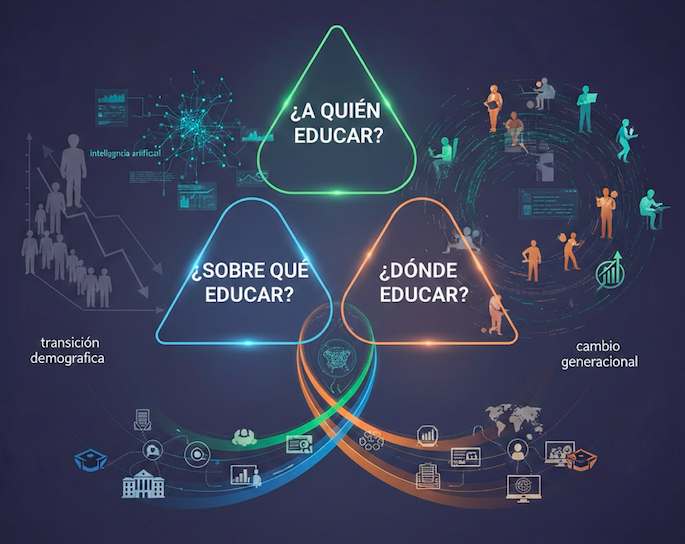
    Higher education is undergoing a structural reconfiguration driven by three converging dynamics: the expansion of artificial intelligence (AI) and digital hyperconnectivity, demographic decline across multiple regions, and the transformation of cultural and professional expectations among younger generations.

    This text reflects on these forces, which compel us to rethink three fundamental strategic questions — Who should we educate? What should we educate about? Where should we educate? — not as isolated pedagogical concerns, but as axes for institutional redesign.

    Based on evidence from international organizations and recent academic literature, it is argued that the sustainability and relevance of higher education will depend on its ability to adopt an intergenerational model, integrate digital literacy transversally, and evolve toward a hybrid educational architecture.

    From Mass Expansion to Structural Reconfiguration
    Over the past decades, higher education experienced unprecedented expansion. According to UNESCO (2022), global enrollment increased from approximately 100 million students in 2000 to more than 235 million in 2020. However, this expansion developed under demographic and technological assumptions that are now being profoundly altered.

    The advancement of artificial intelligence is reshaping work dynamics, learning processes, and knowledge production. UNESCO (2023) warns that AI impacts not only pedagogical tools but also the very architecture of educational systems, including assessment, curriculum design, and institutional governance.

    Simultaneously, the United Nations Population Division reports that the global fertility rate declined to 2.3 children per woman in 2021, projected to fall below replacement level in multiple regions (United Nations, 2022). This phenomenon directly affects the size of university-age cohorts that have traditionally sustained higher education systems.

    Moreover, the generations currently entering educational processes are themselves undergoing transformation. Research on Generation Z shows significant shifts in expectations regarding learning and work. Twenge (2017) documents changes in digital socialization patterns and career priorities, while Gallup (2024) highlights ambivalent perceptions regarding AI’s impact on education and employment.

    Generational transformation extends beyond pedagogical preferences; it reshapes the relationship between education and life planning. Institutions that fail to integrate flexibility, modularity, applied learning, and professional transition support risk losing relevance among students who value both employability and ethical coherence in their educational experience.

    In this context, higher education is not facing a temporary crisis, but a systemic redefinition.

    Who Should We Educate? Demographic Transition and the Shift Toward Lifelong Learning

    Demographic transition represents one of the most structural drivers of change. The World Population Prospects report (United Nations, 2022) confirms a sustained slowdown in youth population growth across Latin America, Europe, and East Asia.

    Encoura (2023) projects a significant decline in high school graduates in the United States over the next decade — a phenomenon mirrored in other countries with reduced fertility rates.

    This scenario transforms institutional logic:

    • Fewer traditional students
    • Increased interinstitutional competition
    • The need to diversify target populations

    The OECD (2019) argues that lifelong learning will be critical for sustaining productivity in aging societies. Consequently, higher education must expand its focus toward:

    • Professionals undergoing reskilling due to automation
    • Adults requiring continuous technological updating
    • Flexible pathways integrating work and study

    The traditional student is no longer the exclusive center of the model. Institutional sustainability will increasingly depend on the ability to operate as a lifelong learning platform.

    What Should We Educate About? AI, Automation, and Expanded Human Competencies

    Artificial intelligence is redefining labor market competencies. The Future of Jobs Report (World Economic Forum, 2023) identifies technological literacy, data analysis, and analytical thinking as rapidly growing skills.

    Brynjolfsson and McAfee (2014) argue that automation transforms not only manual tasks but also cognitive ones, requiring the reconfiguration of professional profiles. UNESCO (2023) emphasizes that responsible AI integration in education must include ethical frameworks, algorithmic transparency, and critical thinking development.

    In this context, transversal training in:

    • Data literacy
    • Applied AI
    • Automation
    • Digital ethics

    becomes a foundational requirement rather than an optional specialization.

    At the same time, literature consistently highlights that automation does not eliminate human value; rather, it shifts it toward higher-order competencies. Technology complements tasks requiring judgment, creativity, and social intelligence.

    Higher education must therefore cultivate hybrid professionals: technologically competent and strong in advanced cognitive capacities.

    Where Should We Educate? Hyperconnectivity and the Expansion of the Learning Ecosystem

    Hyperconnectivity structurally redefines educational space. Castells (2010) describes the “network society” as a system in which knowledge production, circulation, and validation occur through global digital infrastructures. Information is no longer confined to closed institutions but flows continuously within interconnected networks.

    Universities, historically organized as centralized physical spaces, now operate within a distributed architecture of knowledge.

    The COVID-19 pandemic accelerated virtualization processes but did not initiate them. Educational digitalization was already advancing through open learning platforms, digital educational resources, online communities of practice, and global professional networks. The pandemic revealed the fragility of exclusively face-to-face models and the necessity of hybrid institutional capabilities.

    Yet the transformation goes beyond migration to virtual environments. Contemporary learning occurs simultaneously across multiple spaces:

    • Open learning platforms
    • Corporate training environments
    • Specialized digital communities
    • Global professional networks
    • Innovation and entrepreneurship ecosystems
    • Self-directed learning

    Within this context, the emerging higher education model displays distinctive characteristics:

    Hybrid education. Not merely a technical blend of in-person and online formats, but an integrated pedagogical design combining physical, digital, and experiential learning.

    Microcredentials. The OECD (2021) notes that microcredentials certify specific, updatable competencies, enabling flexible and stackable learning pathways that respond to both lifelong learning needs and employer demand for verifiable skills.

    Competency-based assessment. Emphasis shifts from credit accumulation to demonstrable learning outcomes. Certification validates mastery rather than time spent.

    Integration with real productive environments. Learning connects with business projects, living labs, simulations, extended internships, and sectoral challenges. The boundary between classroom and market becomes increasingly porous.

    This redesign also responds to cultural transformation. Generation Z values flexibility, purpose, and immediate applicability of learning (Gallup, 2024). It seeks personalized pathways, relevant experiences, and direct connections between education and employability. Rigid curricular structures lose appeal compared to adaptive, modular models.

    The physical campus does not disappear. However, its function is redefined. It ceases to be the sole node of the educational system and becomes one component within an expanded learning network. It evolves from exclusive container of knowledge to space for encounter, experimentation, social interaction, and academic community building.

    The university of the 21st century is defined not solely by its physical infrastructure, but by its capacity to articulate hybrid ecosystems, digital networks, and productive environments into a coherent and strategic learning experience.

    Final Reflection

    The convergence of demographic transition, cognitive automation, and generational cultural transformation is shaping an environment that is structurally different from the one that gave rise to the traditional university model.

    We are not facing marginal adjustments, but rather a fundamental alteration of the system’s foundational assumptions: the abundance of young populations, the stability of professional profiles, and the centrality of the physical campus as the sole legitimate space for education.

    The emerging scenario is clear: Fewer young students. More transversal technology. Growing expectations for flexibility, purpose, and immediate applicability.

    This context redefines competition in higher education. It is no longer sufficient to expand coverage, diversify programs, or strengthen infrastructure alone. The challenge is to rethink the institutional value proposition in terms of relevance, adaptability, and the capacity to articulate effectively with a dynamic environment.

    Institutions that understand the systemic nature of this convergence will be positioned to redesign their academic architecture, diversify their target populations, and consolidate themselves as lifelong learning platforms. Those that maintain exclusively expansion-driven logics — centered on volume, rigid presenciality, or closed disciplinary segmentation — will face increasing pressures on their long-term sustainability.

    Referencias

    Autor, D. H. (2015). Why are there still so many jobs? Journal of Economic Perspectives, 29(3), 3–30.
    Brynjolfsson, E., & McAfee, A. (2014). The second machine age. W. W. Norton.
    Castells, M. (2010). The rise of the network society. Wiley-Blackwell.
    Encoura. (2023). Regional impacts of the demographic decline on higher education.
    Gallup. (2024). Gen Z and AI in education.
    OECD. (2019). Getting skills right: Future-ready adult learning systems.
    OECD. (2021). Micro-credentials for lifelong learning and employability.
    UNESCO. (2022). Global education monitoring report.
    UNESCO. (2023). AI and the future of education: Disruptions, dilemmas and directions.
    United Nations. (2022). World population prospects 2022.
    World Economic Forum. (2023). Future of jobs report 2023.

    PhD. Wilmer Lopez Lopez – February 2026

  • Cities of the Future: Vincent Callebaut’s Sustainable Urban Vision for Latin America

    Latin America’s rapid urbanization has triggered profound challenges: escalating pollution, overpopulation, inefficient transportation systems, and a scarcity of green spaces. These problems, intensified by social, economic, and infrastructural limitations, necessitate a thorough overhaul of urban design to promote sustainability and resilience. In this critical context, innovative solutions are vital to reshape the region’s future metropolises. Belgian architect Vincent Callebaut provides a visionary response, merging technology, ecology, and urban planning to develop smart, sustainable cities. His proposals—self-sufficient buildings, vertical farms, and renewable energy systems—offer a foundation for a potential urban revolution in Latin America. This prompts the question: How can these ideas be tailored to the region’s distinct realities? This article explores Callebaut’s concepts and assesses their capacity to create more livable, sustainable urban environments in Latin America.

    Vincent Callebaut, born in 1977, is a distinguished architect celebrated for his dedication to ecological architecture and sustainable urbanism. A graduate of the Victor Horta Institute of Architecture in Brussels, he has pioneered projects that seamlessly blend technology, nature, and futuristic design. His philosophy combines ecological architecture, sustainable urban planning, and biomimicry, focusing on resilient, self-sufficient urban centers. Utilizing state-of-the-art technologies, renewable energy, and sustainable materials, his designs aim to transform cities into vibrant, eco-friendly spaces. His numerous awards—Green Practitioner of the Year 2021, Best Execution Architecture 2023, and the Global Quality Silver Pyramid 2024—affirm his standing as a global leader in sustainable architecture.

    For Callebaut, design and aesthetics play a central role in his work—not just as visual elements, but as expressions of a conceptual vision that integrates functionality, innovation, and beauty. His approach is distinguished by meticulous attention to detail and a seamless harmony between form and purpose, allowing his projects to transcend mere utility and become manifestations of a broader vision for the future. In this sense, his futuristic perspective is evident in his use of cutting-edge materials, emerging technologies, and concepts that anticipate evolving social, cultural, and environmental dynamics. Through his work, he not only envisions possible scenarios but brings them to life through designs that challenge conventional boundaries and propose new ways of interacting with the human environment.

    Among his most representative works is the Taijitu project, designed in 2024—a sustainable sports center dedicated to the practice of Tai Chi Chuan. Located in Shenyang, China, on the banks of the Hunhe River, this 4,750 m² complex blends harmoniously with its natural surroundings. Inspired by the Yin-Yang symbol, its biomimetic architecture adopts a double-spiral form that reinterprets traditional curved wooden roof structures, adhering to the principles of balance and symmetry inherent in Chinese culture. The design reflects Callebaut’s philosophy, which seamlessly integrates sustainability, biomimicry, and advanced technology to create highly innovative projects.

    Fuente: https://vincent.callebaut.org/object/241011_taijitu/taijitu/projects

    Fuente: https://vincent.callebaut.org/object/241011_taijitu/taijitu/projects

    Fuente: https://vincent.callebaut.org/object/241011_taijitu/taijitu/projects

    The Dune project (2025), in turn, is an innovative biomimetic architecture proposal that merges urbanism, ecology, and technology to create a self-sufficient and climate-resilient environment. Inspired by the organic forms of dunes and coastal ecosystems, this design incorporates sustainable materials, renewable energy, and natural ventilation systems to optimize resource consumption. With a structure designed to support environmental regeneration, Dune seeks to redefine the relationship between cities and nature, promoting an urban habitat model in harmony with the planet.

    Fuente: https://vincent.callebaut.org/object/240325_dunes/dunes/projects

    Fuente: https://vincent.callebaut.org/object/240325_dunes/dunes/projects

    Fuente: https://vincent.callebaut.org/object/240325_dunes/dunes/projects

    These projects open a pathway for reflection on housing construction in Latin America. The use of recycled materials and innovative techniques, such as self-healing bioconcrete, could provide viable alternatives for developing more durable and sustainable social housing in the region. Likewise, the incorporation of renewable energy, green roofs, and urban farms could enhance the quality of life in densely populated areas. A biomimetic and energy self-sufficiency approach would allow Latin American cities not only to expand but to do so in harmony with their surroundings, simultaneously addressing environmental and social challenges.

    Beyond individual architecture, Callebaut envisions large-scale projects that transform urban planning with a futuristic perspective and an ethic of harmony with nature. A notable example is the Nautilus Eco-Resort, located in Palawan, Philippines. Designed as a biomimetic learning center with zero emissions, zero waste, and zero poverty, this sustainable complex merges ecological architecture with responsible tourism. Featuring 12 spiral towers and modular structures, it integrates renewable technologies such as solar and wind energy, along with water and waste recycling systems. This design aims to foster biodiversity and environmental education, offering a model of self-sufficient and environmentally respectful development.

    Fuente: https://vincent.callebaut.org/object/170831_nautilusecoresort/nautilusecoresort/projects

    Fuente: https://vincent.callebaut.org/object/170831_nautilusecoresort/nautilusecoresort/projects

    Fuente: https://vincent.callebaut.org/object/170831_nautilusecoresort/nautilusecoresort/projects

    Fuente: https://vincent.callebaut.org/object/170831_nautilusecoresort/nautilusecoresort/projects

    Fuente: https://vincent.callebaut.org/object/170831_nautilusecoresort/nautilusecoresort/projects

    In the Latin American context, these types of designs could have a transformative impact on coastal regions vulnerable to climate change and environmental degradation. Biomimetic proposals that integrate renewable energy and recycling could help mitigate the effects of mass tourism and uncontrolled growth in the Mexican Caribbean, the Colombian coasts, and Central American islands. Moreover, by generating green jobs and fostering resilience to extreme climate events, these initiatives would provide solutions tailored to local needs.

    Along the same lines of marine- and ocean-focused innovation, the Lilypad project represents a groundbreaking proposal for a sustainable floating city designed to address the challenges of climate change and rising sea levels. Inspired by the shape of a lotus flower, this city aims to be a self-sufficient refuge for climate refugees, providing housing, community spaces, and agricultural areas. Its design incorporates advanced ecological technologies, including energy generation from solar, wind, and geothermal sources, as well as seawater desalination for potable water supply. The structure is designed to adapt to aquatic environments, featuring floating platforms capable of adjusting to fluctuations in water levels.

    This project embodies Callebaut’s vision of a future where cities not only adapt to environmental conditions but also offer innovative solutions to the global climate crisis. In the Latin American context, particularly in coastal regions vulnerable to rising sea levels and the impacts of climate change, Lilypad could present a viable alternative. Countries such as Colombia, Mexico, Peru, and the Caribbean island nations face severe risks due to sea level rise and the intensification of extreme weather events. The possibility of floating, self-sufficient living spaces could help alleviate pressure on densely populated urban areas, mitigating the adverse effects of uncontrolled urbanization in these regions.

    Fuente: https://vincent.callebaut.org/object/080523_lilypad/lilypad/projects

    Fuente: https://vincent.callebaut.org/object/080523_lilypad/lilypad/projects

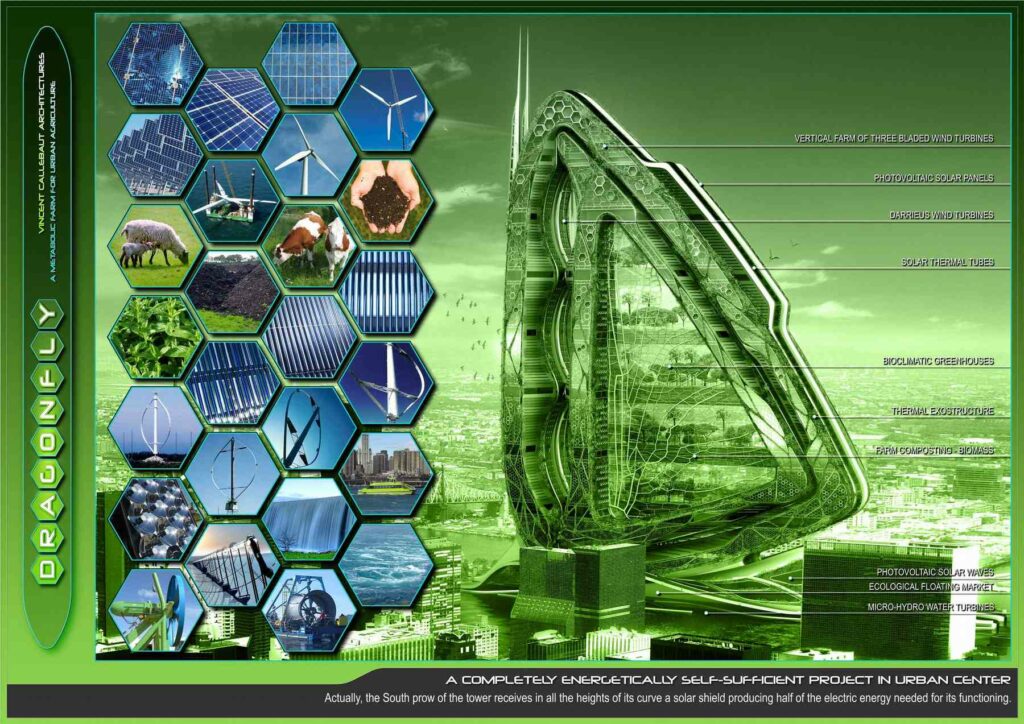
    The Dragonfly project presents a futuristic concept of a sustainable skyscraper, inspired by nature and designed to transform the urban landscape through innovative and eco-friendly architecture. Its structure, reminiscent of a dragonfly’s form, features wings engineered to maximize the capture of solar and wind energy, enabling the building to operate self-sufficiently. Additionally, it integrates green technologies such as solar panels, wind turbines, and water recycling systems, creating an autonomous urban ecosystem that accommodates residential, commercial, and vertical farming spaces.

    With this proposal, Callebaut envisions a future in which buildings not only fulfill conventional functions but also actively contribute to the regeneration of the urban environment. The application of such projects in major Latin American cities could have a significant impact, particularly in São Paulo, Mexico City, Buenos Aires, and Bogotá, where rapid urban growth has led to critical issues such as pollution, traffic congestion, and resource scarcity. The incorporation of sustainable urban models could provide a viable solution to these challenges. Integrating renewable energy, recycling systems, and urban agriculture into contemporary architecture would help reduce cities’ ecological footprints and improve the quality of life for their inhabitants.

    Fuente: https://vincent.callebaut.org/object/090429_dragonfly/dragonfly/projects

    Fuente: https://vincent.callebaut.org/object/090429_dragonfly/dragonfly/projects

    Fuente: https://vincent.callebaut.org/object/090429_dragonfly/dragonfly/projects

    This vision of urban transformation is also reflected in other projects by Callebaut, such as Hyperion and Paris Smart City 2050. Hyperion is an ecological skyscraper concept inspired by the form of a tree, designed to integrate renewable energy and water recycling systems to generate a positive impact on both the environment and urban life.

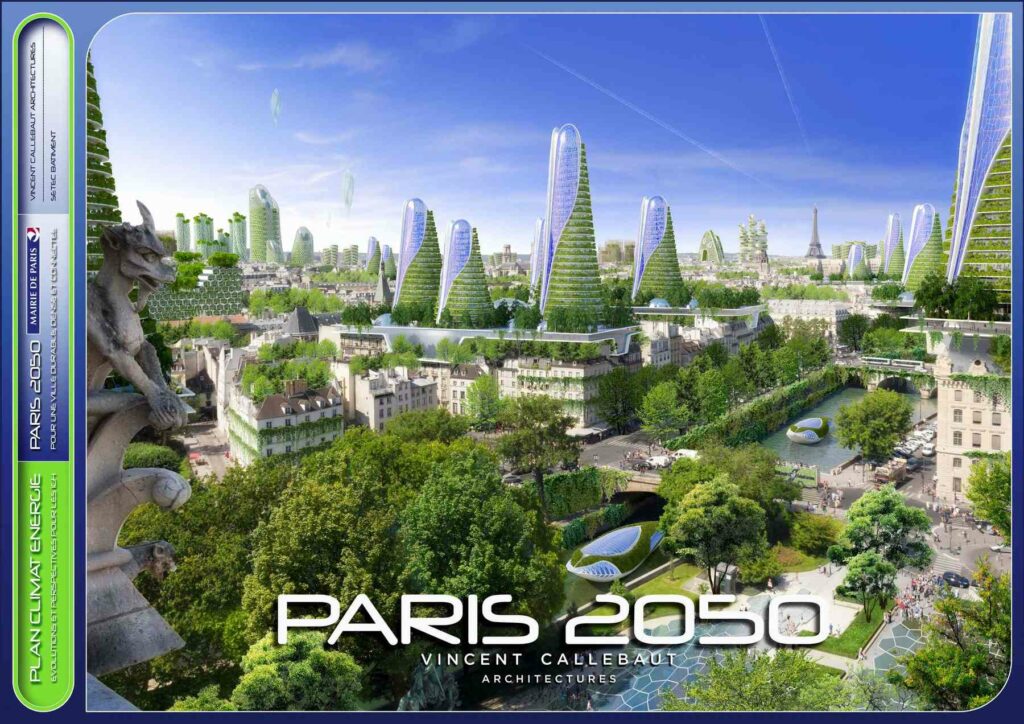
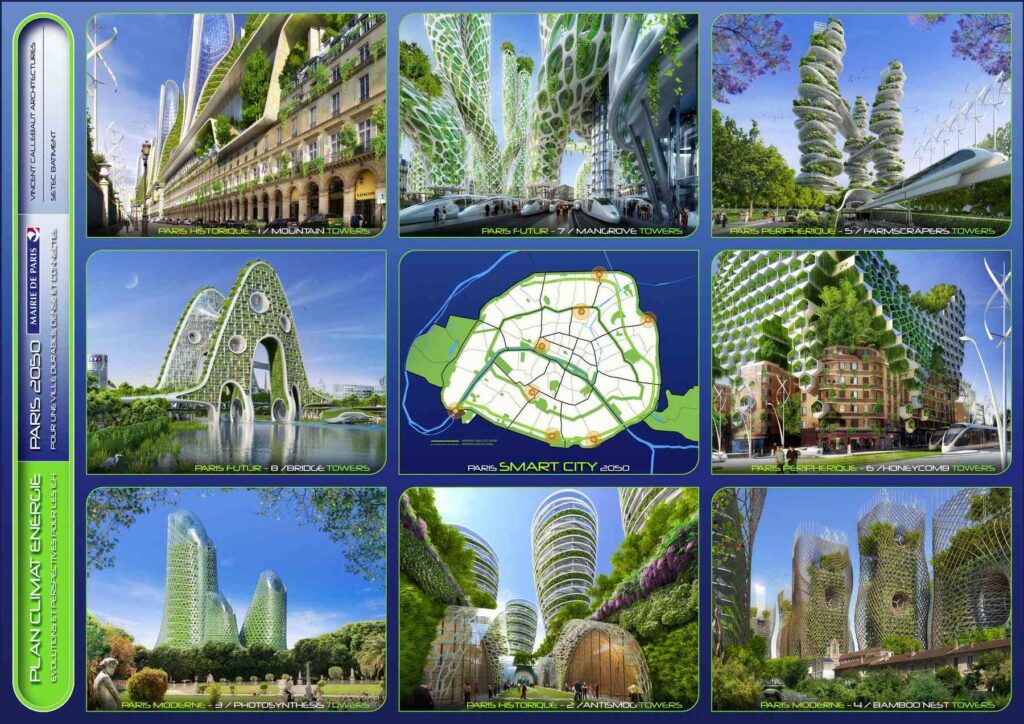
    Meanwhile, Paris Smart City 2050 is a visionary model of a smart and sustainable city that combines advanced architecture, intelligent mobility, efficient resource management, and the integration of green spaces to create resilient and self-sufficient urban environments in the face of climate change challenges. Both projects represent a synthesis of technology, nature, and urban design, shaping a paradigm of sustainable cities for the future.

    Fuente: https://vincent.callebaut.org/object/160220_hyperions/hyperions/projects

    Fuente: https://vincent.callebaut.org/object/160220_hyperions/hyperions/projects

    Fuente: https://vincent.callebaut.org/object/160220_hyperions/hyperions/projects

    In this context, the Paris Smart City 2050 project could serve as a reference for the modernization of cities in Latin America. In a region characterized by rapid urban growth, high levels of inequality, and environmental challenges such as pollution and deforestation, Callebaut’s vision offers adaptable solutions. His proposals include self-sufficient buildings powered by solar or wind energy, the integration of green spaces to mitigate urban heat, and local food production to reduce dependence on external supply chains.

    Megacities such as Bogotá, Mexico City, and São Paulo could benefit from these ideas to ease pressure on resources, improve air quality, and promote a circular economy. The key lies in adapting these designs to local conditions, addressing specific challenges such as tropical rainfall management and the use of regional materials and labor, ensuring a balance between innovation and cultural context.

    Fuente: https://vincent.callebaut.org/object/150105_parissmartcity2050/parissmartcity2050/projects

    Fuente: https://vincent.callebaut.org/object/150105_parissmartcity2050/parissmartcity2050/projects

    Another of his most recent works is Écume des Ondes (2024) in Aix-les-Bains, France, a transformation of the old thermal baths into a sustainable wellness center with undulating green terraces and an aquaponic farm. Flower Tower (2024) in Brussels is a hybrid wooden hospital that prioritizes biophilic design, while Harmocracy (2024) in Neom, Saudi Arabia, is a futuristic airport that optimizes solar energy and natural ventilation.

    Innovative proposals also include Green Line (2023) in Geneva, a car-free eco-district with cascading wooden villas, and Green New Deal (2023) in New York, which reimagines the city with vertical villages designed to reduce emissions by 85% by 2050. In 2022, Manta Ray (Seoul) transformed a disused highway into a productive space with agricultural bridges, while Archibiotec (Paris) created an urban distillery that converts waste into biofuels.

    Meanwhile, Pollinator Park (2020), commissioned by the European Commission, is a virtual park that educates visitors on the importance of pollinators through organic structures simulating natural ecosystems. Conceptual projects such as Hydrogenase (2008) envision zero-emission airships powered by biohydrogen from algae, while Physalia (2007) is a floating garden vessel designed to purify European rivers using solar energy and biofiltration. Perfumed Jungle (2006) in Hong Kong transforms the waterfront into a «green lung» with interwoven ecological towers. Anti-Smog (2005) in Paris, France, is an ecological center that purifies the air through green technologies and biomimetic design. Lastly, Elasticity (2001), an academic project, proposed an autonomous aquatic city for 50,000 people, marking the beginning of Callebaut’s futuristic vision.

    However, implementing these designs in Latin America presents multiple challenges. The uncontrolled expansion of cities and the proliferation of informal settlements complicate sustainable infrastructure planning. Additionally, economic inequality limits equitable access to ecological technologies. Environmental conditions—such as air pollution, deforestation, and climate variability—require specific architectural adaptations to optimize resource management across diverse climates. The integration of a circular economy and the use of local materials can help reduce costs and promote regional employment, but their implementation necessitates structural changes in production and consumption models. Finally, technological infrastructure and community training are essential to ensuring the long-term sustainability of these projects.

    Consequently, a comprehensive approach is required—one that combines innovation, inclusive public policies, and contextual strategies that address the specific needs of each region.

    Callebaut’s urban vision offers an innovative framework for rethinking the design of future cities, integrating technology, ecology, and functionality into a model of sustainable urbanism. His proposals not only anticipate the challenges of climate change and urban expansion but also present viable solutions to reduce environmental impact and improve quality of life in densely populated environments. In the Latin American context, where cities face structural issues such as inequality, pollution, and infrastructure deficits, adapting these concepts is crucial. However, their implementation demands coordinated public policies, technological investment, and a shift in urban planning that prioritizes sustainability and resilience.

    Beyond aesthetics and architectural innovation, the real challenge lies in transforming these ideas into tangible, accessible solutions tailored to local realities. The future of cities will depend on the ability to merge vision with action, adopting strategies that enable a balanced development between urban growth and environmental preservation.

    Note: I am deeply grateful to Professor Carolina Espitia for highlighting the importance of climate change awareness through the Latin American Chair of Environmental Thought and Climate Crisis at Universidad Central. Her guidance has inspired me to reflect and take action toward a sustainable future.

    References: Callebaut, V. (2025). Projects. Vincent Callebaut Architectures. https://vincent.callebaut.org/