Higher Education at the Convergence of Artificial Intelligence, Demographic Transition, and Generational Change
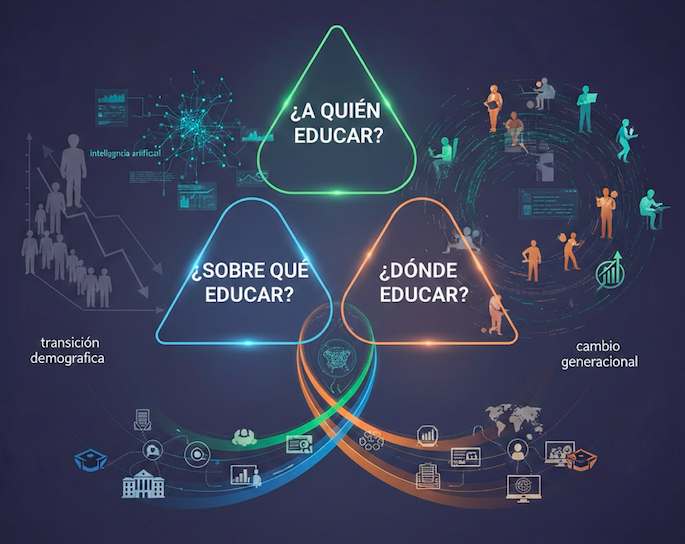
Higher education is undergoing a structural reconfiguration driven by three converging dynamics: the expansion of artificial intelligence (AI) and digital hyperconnectivity, demographic decline across multiple regions, and the transformation of cultural and professional expectations among younger generations.
This text reflects on these forces, which compel us to rethink three fundamental strategic questions — Who should we educate? What should we educate about? Where should we educate? — not as isolated pedagogical concerns, but as axes for institutional redesign.
Based on evidence from international organizations and recent academic literature, it is argued that the sustainability and relevance of higher education will depend on its ability to adopt an intergenerational model, integrate digital literacy transversally, and evolve toward a hybrid educational architecture.
From Mass Expansion to Structural Reconfiguration
Over the past decades, higher education experienced unprecedented expansion. According to UNESCO (2022), global enrollment increased from approximately 100 million students in 2000 to more than 235 million in 2020. However, this expansion developed under demographic and technological assumptions that are now being profoundly altered.
The advancement of artificial intelligence is reshaping work dynamics, learning processes, and knowledge production. UNESCO (2023) warns that AI impacts not only pedagogical tools but also the very architecture of educational systems, including assessment, curriculum design, and institutional governance.
Simultaneously, the United Nations Population Division reports that the global fertility rate declined to 2.3 children per woman in 2021, projected to fall below replacement level in multiple regions (United Nations, 2022). This phenomenon directly affects the size of university-age cohorts that have traditionally sustained higher education systems.
Moreover, the generations currently entering educational processes are themselves undergoing transformation. Research on Generation Z shows significant shifts in expectations regarding learning and work. Twenge (2017) documents changes in digital socialization patterns and career priorities, while Gallup (2024) highlights ambivalent perceptions regarding AI’s impact on education and employment.
Generational transformation extends beyond pedagogical preferences; it reshapes the relationship between education and life planning. Institutions that fail to integrate flexibility, modularity, applied learning, and professional transition support risk losing relevance among students who value both employability and ethical coherence in their educational experience.
In this context, higher education is not facing a temporary crisis, but a systemic redefinition.
Who Should We Educate? Demographic Transition and the Shift Toward Lifelong Learning
Demographic transition represents one of the most structural drivers of change. The World Population Prospects report (United Nations, 2022) confirms a sustained slowdown in youth population growth across Latin America, Europe, and East Asia.
Encoura (2023) projects a significant decline in high school graduates in the United States over the next decade — a phenomenon mirrored in other countries with reduced fertility rates.
This scenario transforms institutional logic:
- Fewer traditional students
- Increased interinstitutional competition
- The need to diversify target populations
The OECD (2019) argues that lifelong learning will be critical for sustaining productivity in aging societies. Consequently, higher education must expand its focus toward:
- Professionals undergoing reskilling due to automation
- Adults requiring continuous technological updating
- Flexible pathways integrating work and study
The traditional student is no longer the exclusive center of the model. Institutional sustainability will increasingly depend on the ability to operate as a lifelong learning platform.
What Should We Educate About? AI, Automation, and Expanded Human Competencies
Artificial intelligence is redefining labor market competencies. The Future of Jobs Report (World Economic Forum, 2023) identifies technological literacy, data analysis, and analytical thinking as rapidly growing skills.
Brynjolfsson and McAfee (2014) argue that automation transforms not only manual tasks but also cognitive ones, requiring the reconfiguration of professional profiles. UNESCO (2023) emphasizes that responsible AI integration in education must include ethical frameworks, algorithmic transparency, and critical thinking development.
In this context, transversal training in:
- Data literacy
- Applied AI
- Automation
- Digital ethics
becomes a foundational requirement rather than an optional specialization.
At the same time, literature consistently highlights that automation does not eliminate human value; rather, it shifts it toward higher-order competencies. Technology complements tasks requiring judgment, creativity, and social intelligence.
Higher education must therefore cultivate hybrid professionals: technologically competent and strong in advanced cognitive capacities.
Where Should We Educate? Hyperconnectivity and the Expansion of the Learning Ecosystem
Hyperconnectivity structurally redefines educational space. Castells (2010) describes the “network society” as a system in which knowledge production, circulation, and validation occur through global digital infrastructures. Information is no longer confined to closed institutions but flows continuously within interconnected networks.
Universities, historically organized as centralized physical spaces, now operate within a distributed architecture of knowledge.
The COVID-19 pandemic accelerated virtualization processes but did not initiate them. Educational digitalization was already advancing through open learning platforms, digital educational resources, online communities of practice, and global professional networks. The pandemic revealed the fragility of exclusively face-to-face models and the necessity of hybrid institutional capabilities.
Yet the transformation goes beyond migration to virtual environments. Contemporary learning occurs simultaneously across multiple spaces:
- Open learning platforms
- Corporate training environments
- Specialized digital communities
- Global professional networks
- Innovation and entrepreneurship ecosystems
- Self-directed learning
Within this context, the emerging higher education model displays distinctive characteristics:
Hybrid education. Not merely a technical blend of in-person and online formats, but an integrated pedagogical design combining physical, digital, and experiential learning.
Microcredentials. The OECD (2021) notes that microcredentials certify specific, updatable competencies, enabling flexible and stackable learning pathways that respond to both lifelong learning needs and employer demand for verifiable skills.
Competency-based assessment. Emphasis shifts from credit accumulation to demonstrable learning outcomes. Certification validates mastery rather than time spent.
Integration with real productive environments. Learning connects with business projects, living labs, simulations, extended internships, and sectoral challenges. The boundary between classroom and market becomes increasingly porous.
This redesign also responds to cultural transformation. Generation Z values flexibility, purpose, and immediate applicability of learning (Gallup, 2024). It seeks personalized pathways, relevant experiences, and direct connections between education and employability. Rigid curricular structures lose appeal compared to adaptive, modular models.
The physical campus does not disappear. However, its function is redefined. It ceases to be the sole node of the educational system and becomes one component within an expanded learning network. It evolves from exclusive container of knowledge to space for encounter, experimentation, social interaction, and academic community building.
The university of the 21st century is defined not solely by its physical infrastructure, but by its capacity to articulate hybrid ecosystems, digital networks, and productive environments into a coherent and strategic learning experience.
Final Reflection
The convergence of demographic transition, cognitive automation, and generational cultural transformation is shaping an environment that is structurally different from the one that gave rise to the traditional university model.
We are not facing marginal adjustments, but rather a fundamental alteration of the system’s foundational assumptions: the abundance of young populations, the stability of professional profiles, and the centrality of the physical campus as the sole legitimate space for education.
The emerging scenario is clear: Fewer young students. More transversal technology. Growing expectations for flexibility, purpose, and immediate applicability.
This context redefines competition in higher education. It is no longer sufficient to expand coverage, diversify programs, or strengthen infrastructure alone. The challenge is to rethink the institutional value proposition in terms of relevance, adaptability, and the capacity to articulate effectively with a dynamic environment.
Institutions that understand the systemic nature of this convergence will be positioned to redesign their academic architecture, diversify their target populations, and consolidate themselves as lifelong learning platforms. Those that maintain exclusively expansion-driven logics — centered on volume, rigid presenciality, or closed disciplinary segmentation — will face increasing pressures on their long-term sustainability.
Referencias
Autor, D. H. (2015). Why are there still so many jobs? Journal of Economic Perspectives, 29(3), 3–30.
Brynjolfsson, E., & McAfee, A. (2014). The second machine age. W. W. Norton.
Castells, M. (2010). The rise of the network society. Wiley-Blackwell.
Encoura. (2023). Regional impacts of the demographic decline on higher education.
Gallup. (2024). Gen Z and AI in education.
OECD. (2019). Getting skills right: Future-ready adult learning systems.
OECD. (2021). Micro-credentials for lifelong learning and employability.
UNESCO. (2022). Global education monitoring report.
UNESCO. (2023). AI and the future of education: Disruptions, dilemmas and directions.
United Nations. (2022). World population prospects 2022.
World Economic Forum. (2023). Future of jobs report 2023.
PhD. Wilmer Lopez Lopez – February 2026